
Find Blue Springs Resident Records
Blue Springs sits inside Jackson County. Yet the county seat lies elsewhere. That split matters for any resident lookup. City hall holds meeting minutes, project files, reports, and address actions. County systems tie land to a legal description. They do it through property rolls and recorded deeds. Courts and state agencies keep entirely separate subjects. Start with the narrowest official record that fits the question. Then test the name or address against a second source before trusting any single result.
- Write the full name, spelling variants, approximate year, known street address, and whether the question concerns a person, parcel, court matter, or historical household.
- For an address, use the county property record to capture the situs, parcel identifier, and legal description.
- For a historical name, compare dated directories, newspaper material, or archives instead of treating a current property field as a past household list.
- For a public city action, ask for a record category and date range, not every record that may mention a person.
- For a court result, match the division, filing date, and role before treating a same-name result as relevant.
- Compare two independent clues, such as a deed and a directory page, before connecting a person to a Blue Springs address.
- Save the official source, search mode, date, and record identifier so a later check can repeat the work.
A voter and a grantor play different roles. The Blue Springs residents directory is most useful when a property owner, a litigant, and a name in a historical directory stay clearly separated. A missing match can mean several things. The index may be incomplete, the address protected, the jurisdiction different, or the record held back until a formal request.
Blue Springs Resident Records Offices
Blue Springs records sit with several custodians. The City Clerk keeps council history, resolutions, ordinances, and older municipal material. The Recorder holds recorded instruments and marriage certificates. Property and parcel context belongs to the Collector and GIS systems, while the 16th Judicial Circuit keeps the court files. Sending a request to the wrong office wastes time. Routing it to the right custodian beats any unfocused name search.
Blue Springs City Clerk
City Council minutes, resolutions, ordinances, legislative history, and pre-2015 council records. Requests can be written, online, mailed, emailed, or delivered to City Hall.
Jackson County Recorder
Deeds, deeds of trust, releases, liens, plats, marriage records, and UCC material. The online land inventory is strongest from about 1961 forward.
Collector and GIS
Current property account, owner field, situs, mailing address, PIN, legal description, parcel map, values, districts, and map tools.
16th Judicial Circuit
Civil, criminal, family, probate, and municipal matters through Missouri Case.net and division-specific court routes.
Recent city council records are posted online. Council records before 2015 go to the City Clerk. The city answers most public-record requests within three business days, or sends a written explanation of any delay or denial in that window. Fees may apply to some requests. Be specific. Naming a date range, street, project, record series, or ordinance reference speeds everything along. The Blue Springs public-record request guidance shows the City Clerk route for current and older municipal records.
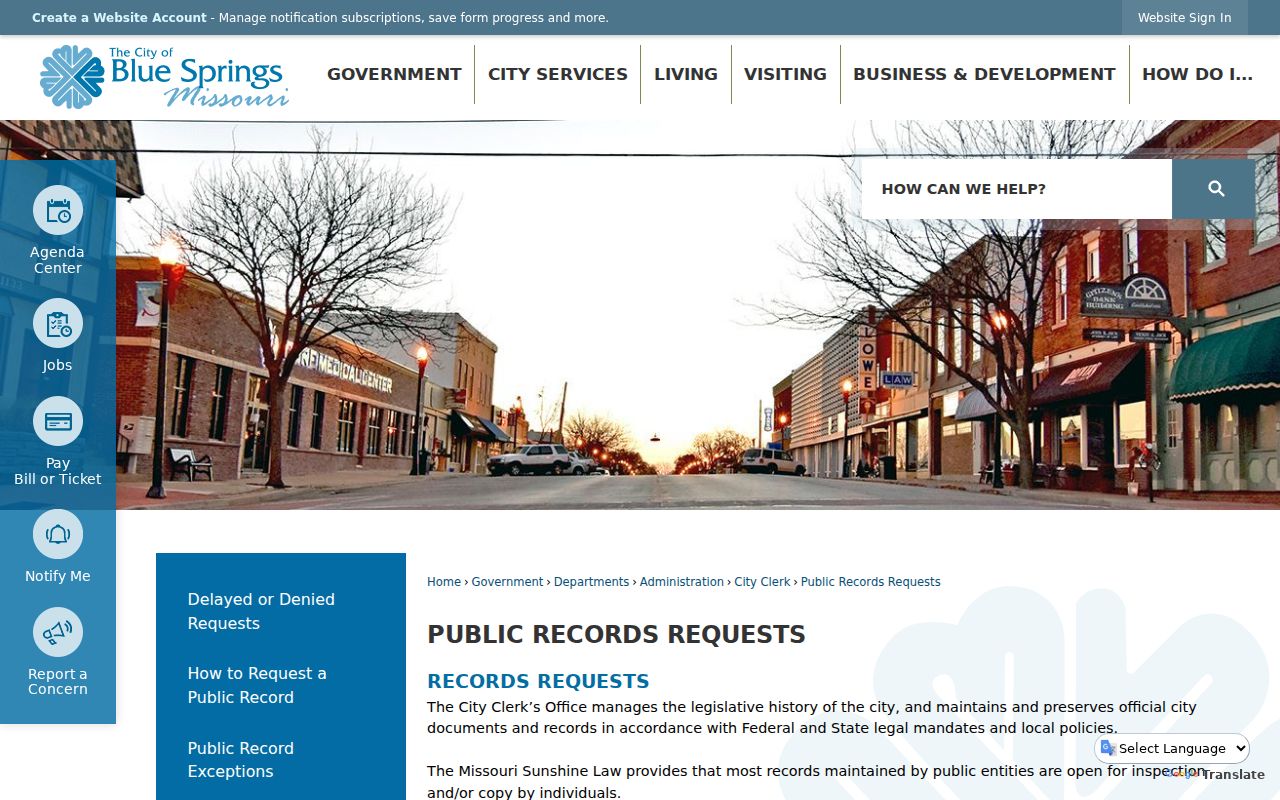
Use the city request channel as a fallback. It fits when a record has no public search form, or when an older council item needs staff retrieval. Most lookups never need it. Note: A request that names the record series, date range, and street or project gives the custodian a clear starting point.
Blue Springs Parcel Records by Address
Begin with the Jackson County Collector tax search. It offers PIN, Primary Owner, Property Address, and Mailing Address modes. Property Address mode answers where a parcel sits. A mailing address can instead point to an owner, trust, agent, or business, so read it as a correspondence contact rather than the parcel's location or a current household. Broad searches stop at 200 results. A narrow query beats a sprawling one. Entering the full street name keeps results tight. The Jackson County's public tax search displays the address, owner, PIN, and mailing-address routes that form the first parcel check.
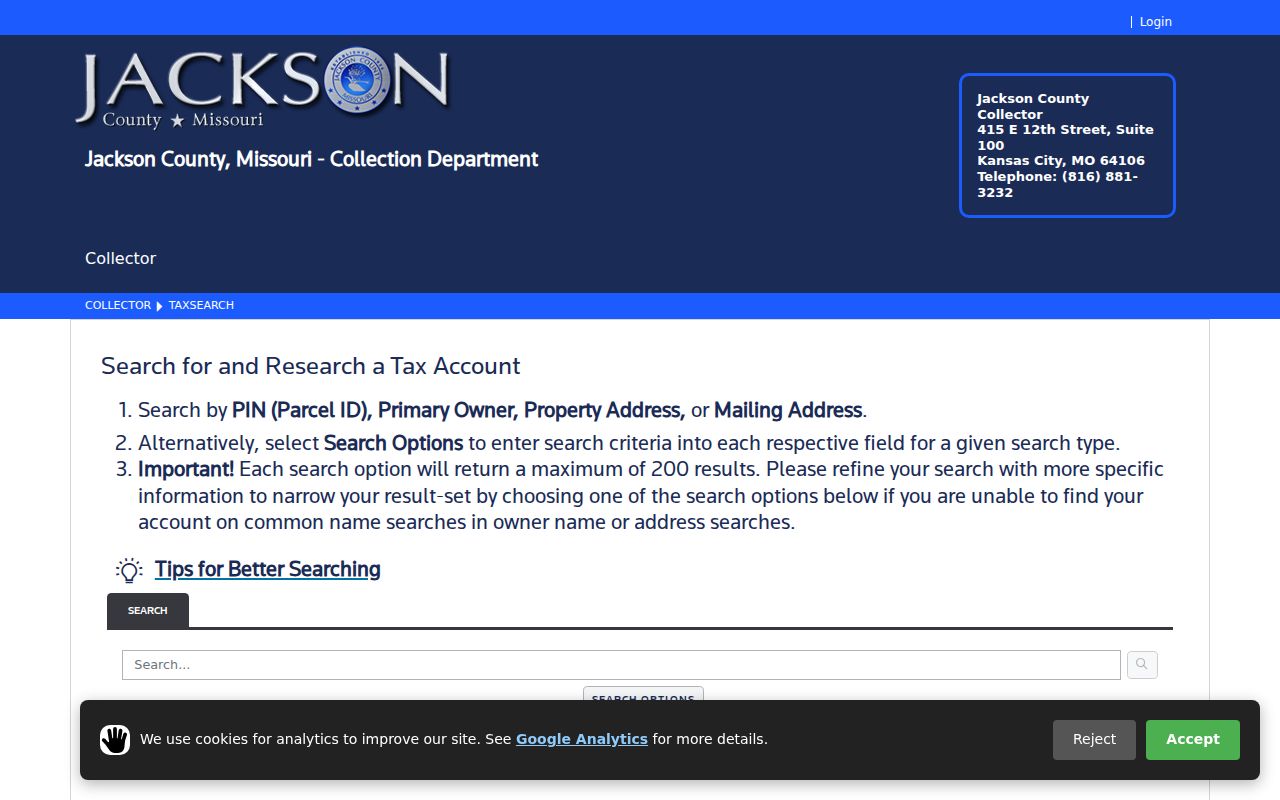
Write down the PIN first. Then open that parcel in the GIS viewer and keep the legal description beside the street address. It bridges cleanly to an older deed or plat.
| Record field | What it means | Use with care |
|---|---|---|
| PIN | Parcel identifier used across property systems | Real-property PINs use a 24-character dashed pattern |
| Property address | Situs or physical parcel location | Check directional, street type, unit, and postal label |
| Primary owner | Ownership or tax-account field | Does not establish present occupancy |
| Mailing address | Tax correspondence address | Can be outside Blue Springs or outside Jackson County |
| Legal description | Lot, block, subdivision, tract, or metes-and-bounds language | Use it to search deeds and resolve old address labels |
- Parcel
- A defined piece of land recorded in the county property system.
- Situs address
- The physical address assigned to a parcel, distinct from a tax mailing address.
- Legal description
- The land description used in deeds and plats, often more durable than a street address.
- Grantor and grantee
- The parties conveying and receiving an interest in a recorded instrument.
The Jackson County GIS Parcel Viewer adds parcel geometry, owner and address fields, legal descriptions, districts, and map and PDF tools. Treat it as a mapping and assessment aid, not a survey. Its dimensions are not survey-grade. Research easements through recorded documents instead.
Blue Springs Current Resident Directories
No public roster lists everyone in Blue Springs. Current sources each document a role instead. The county property system can tie a name to a parcel. A city staff directory routes requests to offices, not residents. Voter tools handle registration and district details. They use exact identity fields. Council agendas and minutes can surface a project, street, or public action. Pick the source that matches the relationship being verified.
| Source | Who or what it can show | Keeper | Access |
|---|---|---|---|
| Collector property search | Owner field, situs, mailing address, PIN, tax context | Jackson County Collector | Public search with PIN, owner, address, and mailing modes |
| City staff directory | Public office and staff routing | City of Blue Springs | Category, first-name, and last-name search; not a resident roster |
| Voter outreach and JCEB | Registration, district, and election information where eligible | Missouri and Jackson County Election Board | Exact-data lookup or written request |
| City Clerk and Agenda Center | Public meetings, actions, projects, ordinances, and historical requests | City of Blue Springs | Online records or Missouri Sunshine Law request |
| Recorder index | Recorded land or marriage instrument and party roles | Jackson County Recorder | Online index and images where digitized; microfilm for gaps |
| Official record trail | Names the custodian, record type, date, search fields, and limits so a reader can verify the result. |
|---|---|
| Compiled commercial listing | May merge common names, stale addresses, and unrelated households. It is not used to fill an official-source gap. |
A parcel owner field or a staff-directory entry only shows a role inside that system. Note: Neither one proves that a person presently resides at an address in Blue Springs.
Blue Springs Recorder Name Trails
Jackson County Recorder of Deeds records offer the strongest local bridge. They connect a parcel to a dated land transaction. The Aumentum portal has three areas. Official Public Records, Marriage Records, and UCC each get their own section. Its online guide counts nearly ten million documents. That archive reaches back to the county's 1826 beginning. Real-estate images run deepest from about 1961 forward. Selected historical material reaches earlier, and non-digitized items remain on microfilm. A deed fixes a legal filing, not a move-in date. Blue Springs residence today is a question the Recorder's instruments cannot answer alone.
| Portal area | Field or control | Practical use |
|---|---|---|
| Official Public Records | Grantor, grantee, or general name | Search surname and given name in the appropriate party role, then narrow by date or document type. |
| Real-estate index | Subdivision, lot, block, parcel, and related criteria | Use a legal description when a current street string does not locate an older document. |
| Marriage index | Name, license number, application date, date of marriage | Search by a practical combination and request a certified copy through the separate process. |
| UCC index | Debtor or secured-party criteria | Separate from real estate; the indexed online range stated is 1972-1996. |
Each entry lists a grantor and a grantee. You also see the document type, the recording date, and the legal description. Some records use an instrument number, others a book and page. Image availability varies by record. Need a full current address chain? The Blue Springs street directory fits better than a name-only recorder search.
Blue Springs Voter Record Boundaries
Blue Springs voters outside the Kansas City election jurisdiction go to the Jackson County Election Board. The Missouri Voter Outreach Portal is the state lookup. It asks for a first and last name, date of birth, and county. The last four Social Security digits are required too. The match must be exact. A nickname, an alternate spelling, a county mismatch, a protected record, or an inactive registration can all return nothing.
RSMo 115.157 sets out the public voter-list fields. Name, address components, precinct, ward or township, and districts are public. Protections still apply for undercover, witness-protection, and domestic-violence addresses. RSMo 115.158 bars commercial use of the master list outside its election-related exceptions. Need a full list or a map? The Election Board's written public-record request covers that, with a specific date period and delivery method. A voter tool is not a general people finder.
Use the smallest record that answers the question. A protected or absent address is not a reason to search around the safeguard. That is the responsible approach for any resident lookup.
Blue Springs Court Search Details
Blue Springs Municipal Court handles city code and ordinance violations. It sits within Missouri's 16th Judicial Circuit. The city places the court at 1100 SW Smith Street. It points current docket users to Case.net. The circuit also runs civil, criminal, family, probate, and municipal divisions. Match the court and division first. City matters, Jackson County municipal payments, circuit cases, and federal dockets live in separate systems.
Missouri Case.net supports searching by case number, litigant name, filing date, hearing, judgment index, or court and division. A result can show parties, case type, filing date, docket entries, public events, and disposition. Add a first name and a date range. Jackson County or the right division narrows it further. A filing or charge is not proof of wrongdoing. A docket event is not an adjudicated finding. The Blue Springs Municipal Court information page supplies routing and contact details. It serves the city court directly.
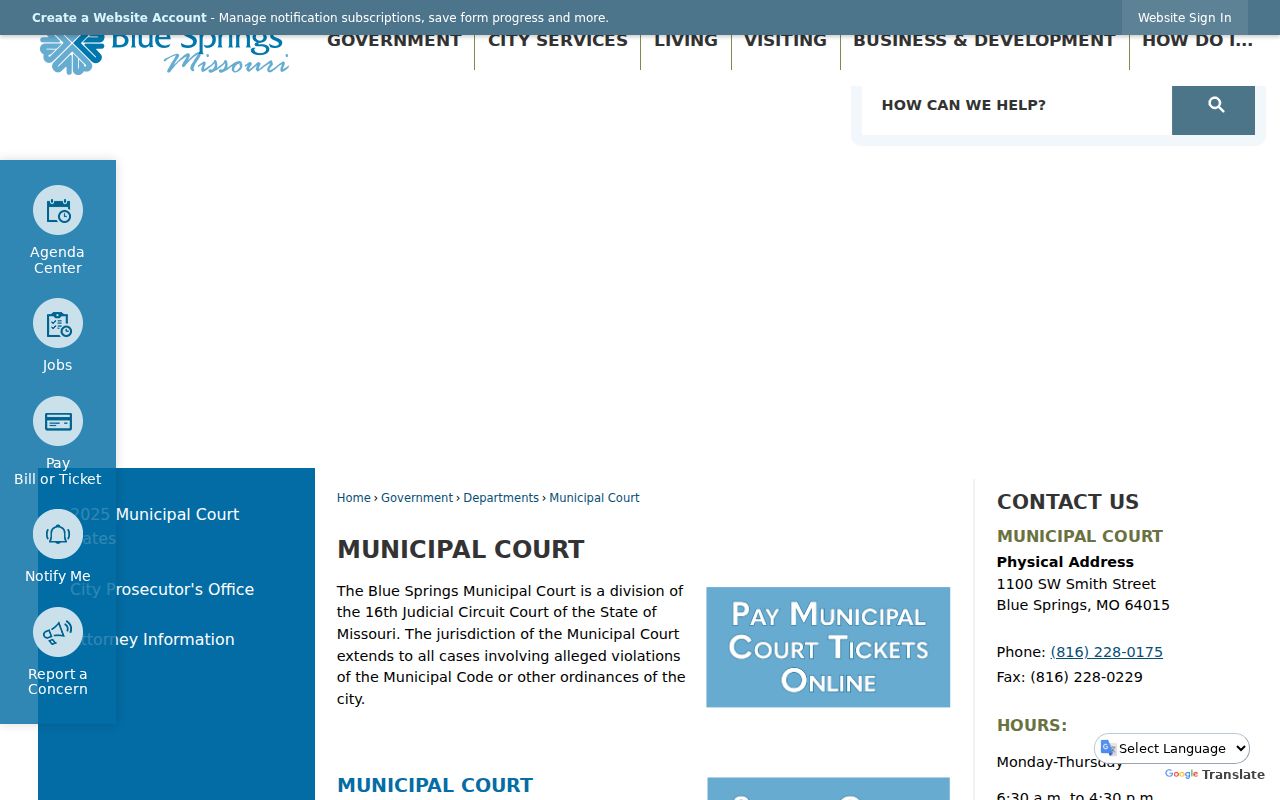
Older city matters from before June 1, 2022 may follow a city ticket or court-record route. Later matters use the state court and e-filing path. Sealed, confidential, juvenile, and protected cases may stay hidden.
Blue Springs Historical Resident Directories
For old Blue Springs directory volumes, the Midwest Genealogy Center of Mid-Continent Public Library holds the clearest shelf. Its phonefiche collection sits at call number 40128 and spans 1987, 1989 through 1993, 1995 through 1997, and 2001. Volumes from 1990 to 1993 carry a Blue Springs-Grain Valley label. The later ones are labeled Blue Springs area instead. Gaps remain, though. Nothing covers 1988, 1994, 1998 through 2000, or anything after 2002. Any hit is a snapshot from one edition, not a running account of who lived where year to year.
The MGC Quick Look index works as a finding aid across titles, names, and dates in obituaries, articles, marriages, wills, cemetery material, and local histories. It is incomplete. Some items may need an in-person visit or a request pull. The Blue Springs Examiner exists on MGC microfilm from January 3, 1991 to July 31, 2003, and its related obituary index runs roughly 1900 to 1959, so grab the source page and publication date whenever you find a name.
The official Blue Springs history adds a useful records clue. The settlement grew around spring water, a grist mill, and the Little Blue River, then shifted toward the Chicago and Alton Railroad station announced in 1878. That is why older records may tag the same community with a township, post-office, railroad, creek, mill, tract, or later street label.
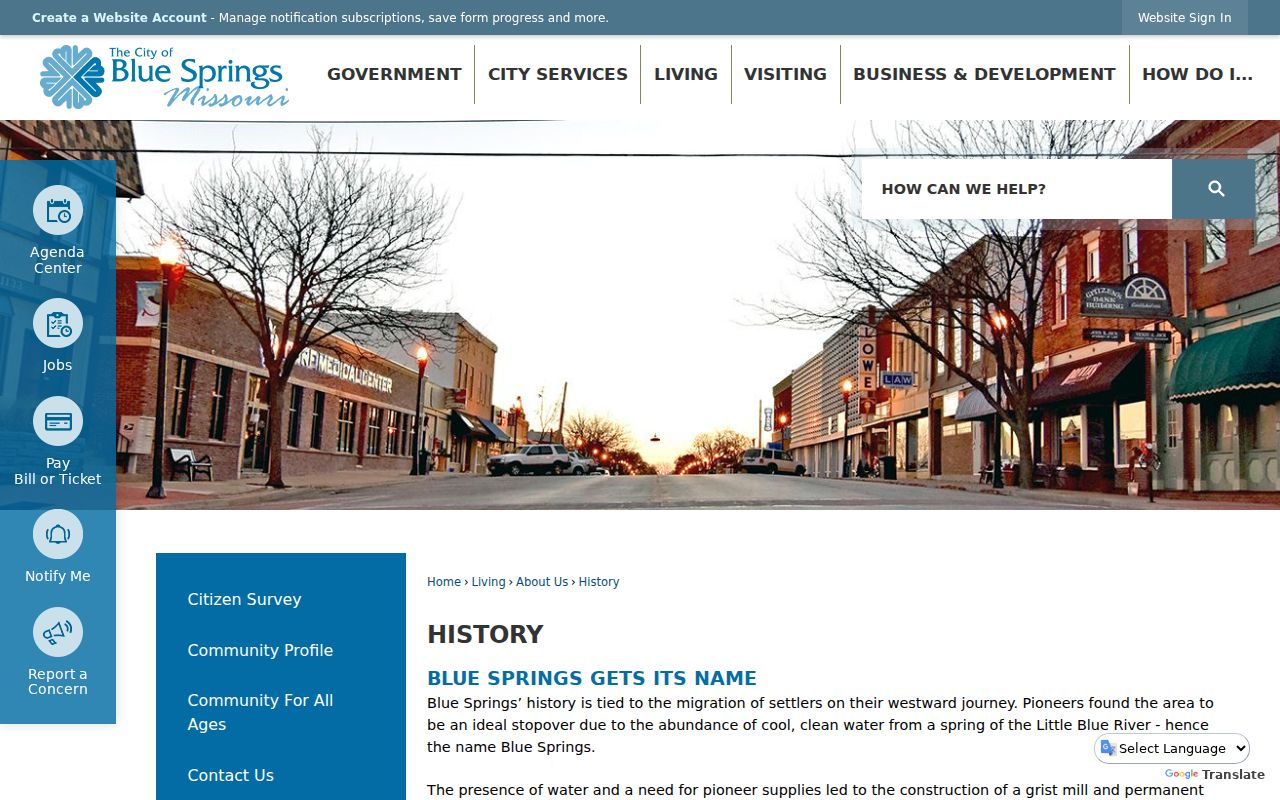
Read every record in its own geographic language. A directory, newspaper, or land entry names places as its era knew them. Compare it against a deed, map, parcel description, or dated municipal source. Only then translate it to a modern address.
Note: A historic post-office or railroad label marks a period context. It is not a present Blue Springs municipal boundary.
Blue Springs Archive Search Paths
Historical gaps call for a different kind of repository. The Midwest Genealogy Center supplies local research help, maps, yearbooks, family histories, oral histories, archival collections, and a Digital Gallery. The Jackson County Historical Society holds regional photographs, streetscapes, deeds, plats, wills, and genealogical material. Its research room works by appointment. Allow at least a week for a request. These are historical sources rather than current resident rosters.
Missouri State Archives and Digital Heritage carry the permanent state records. The state historical death database covers certificates from 1910 through 1975. Deaths past 50 years move to the Archives. Images and indexing vary. A historical search does not create a certified record. Census schedules open to the public through 1950 under the 72-year rule, giving federal household context. Pair a historical name with a date, collection title, page or item number, and a place label.
Blue Springs has no verified Sanborn map edition. A request to MGC, a regional archive, or the Library of Congress guide is the right next step. Do not guess a map year. The same caution fits a missing microfilm image or a noncataloged local collection.
Blue Springs ZIP Labels Differ
A postal ZIP never traces a city line. State and city material names 64013, 64014, and 64015 as the core Blue Springs ZIP associations. The 64014 USPS station sits at 500 SW South Avenue. Some city-related material still carries Grain Valley 64029 or Lee's Summit 64064 labels. Utility or service coverage is only a lead. It is never proof that every address in a ZIP sits inside Blue Springs.
A 2008 city archive file holds a request. It asks to align postal designations with municipal boundaries where 64029 and 64064 labels apply. That file splits 64014 east of Missouri 7 from 64015 west of Missouri 7. It stops short of proving any universal postal change. The Blue Surf Bay service-area list adds 64057 and 64086, but recreation service says nothing about where the city boundary runs.
Start with the full delivery address for any postal check. Then confirm municipal status through the county GIS parcel. The legal description and city annexation or planning records also help. A 2026 agenda or annexation item can be searched by project identifier, date, exhibit, and final ordinance or minutes. The Blue Springs ZIP code directory gathers the boundary cautions for each ZIP in one place.
Blue Springs Custody Record Limits
Custody and registry tools have narrow scopes. The Jackson County Detention Center search is a current selected-occupant route, not an arrest record, court record, or full jail-history database. Jackson County excludes the Regional Correctional Center's municipal matters. The Missouri Department of Corrections active offender tool covers people who are incarcerated or supervised, including probation or parole. Discharged records are not included. Status is time-sensitive. Safety, security, or confidentiality rules can withhold fields.
For that limited active-offender scope, Missouri's active offender search is the official status route.
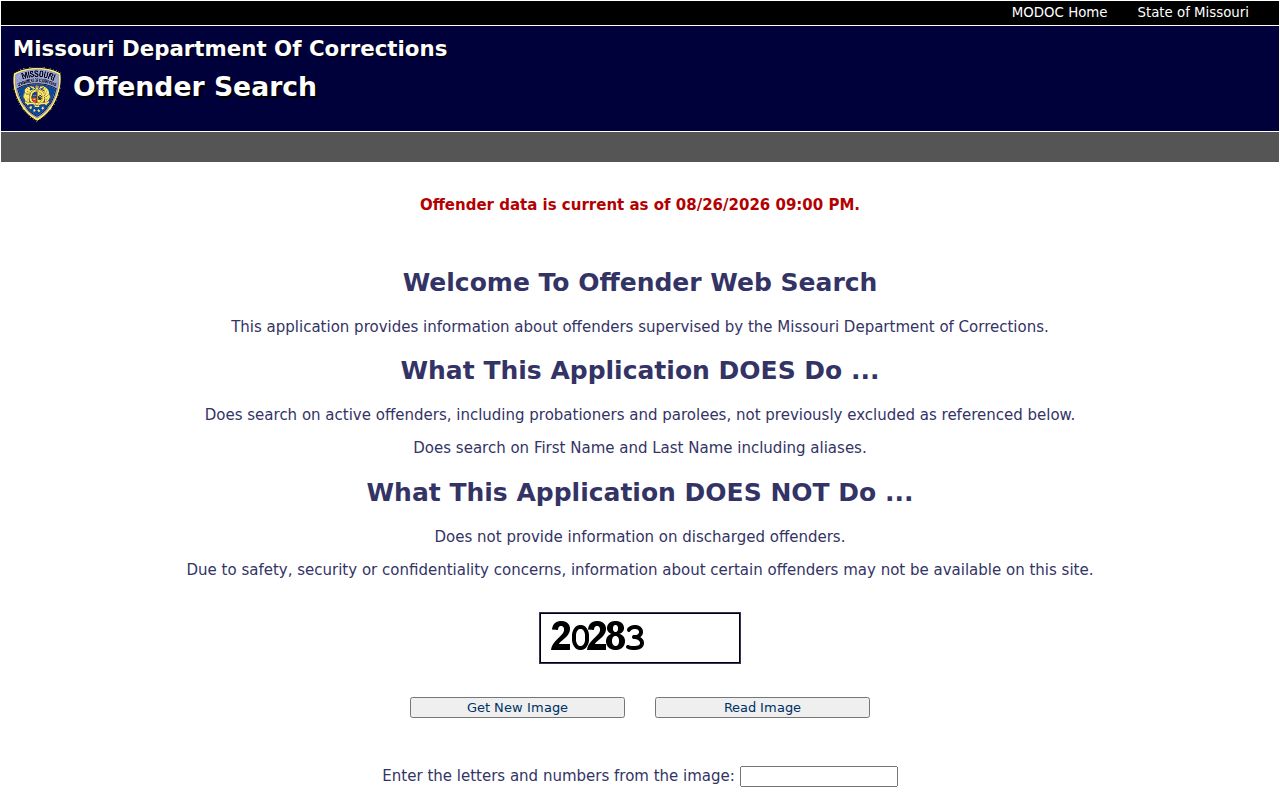
Record the date the source displays. Confirm any court outcome through the court custodian. A no-result can mean the source simply does not cover the historical period or current status at issue.
The Missouri State Highway Patrol registry search offers name, date-of-birth, tier, address, city, county, ZIP, and map-distance criteria. It requires at least one criterion. It describes a statutory registry, not a full criminal-history search or risk assessment.
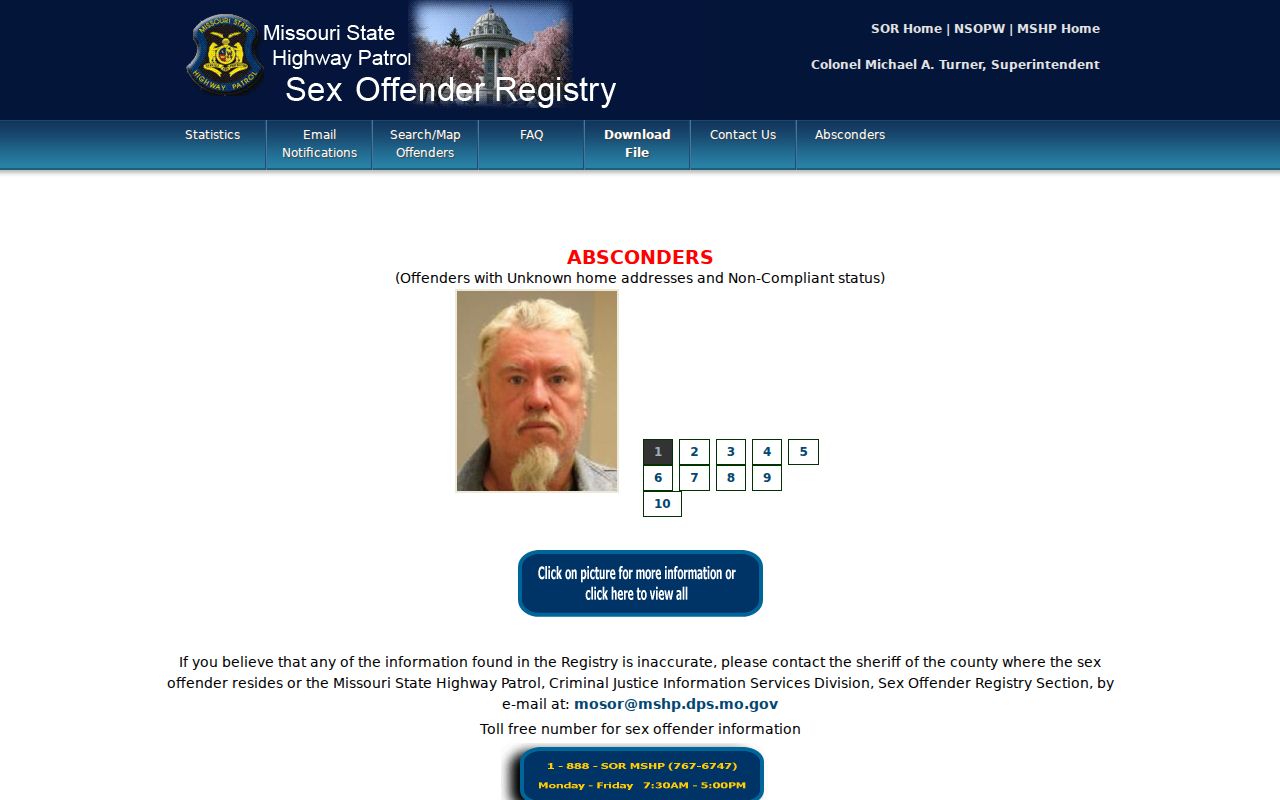
Registry information can change. Agencies attach accuracy and safety warnings to it. Never use a custody or registry result to infer guilt, current residence, or an identity match that is not verified.
Note: Save the status date the source displays, because custody and registry information can change after a search is performed.
Blue Springs Protected Address Rules
Some absent records are working as designed. Missouri Safe at Home gives eligible participants a substitute address and mail-forwarding arrangement that government agencies and courts accept for new records. The voter process uses a code instead. Local authorities never receive the confidential location. Sealed court material, juvenile records, protected public-safety addresses, and restricted vital records carry separate legal safeguards. Certain voter addresses do too.
A public-record request should never try to reverse a substitute address or expose a protected location, and records offices will refuse it anyway. Certified birth and death copies require direct and tangible interest under RSMo 193.255 and the related Missouri regulations. The Recorder handles marriage certificates. The granting circuit clerk issues divorce decrees. Keep a request focused on a public series, date range, and lawful purpose, and let the custodian identify closed material.
Use records lawfully. Blue Springs records can support family history, estate work, civic research, and personal safety questions. Do not use names, addresses, or record links to stalk, harass, or harm anyone.
Blue Springs Research Recordkeeping
Good research keeps a source trail. Resist the urge to build a profile from scattered fragments. For every Blue Springs result you pull, write down the office that holds the record, the URL, the search mode you used, and the date you checked it. Add the name spelling, the address or legal description, the result identifier, and any limitation the source itself states. Note the person's role in the record too. Were they owner, party, officer, voter, historical household member, or current occupant? That role, paired with the date, often matters more than a name that simply matches.
Dynamic systems shift under you. The Recorder cautions that online coverage is uneven. City records before 2015 travel a different request route. MGC indexes have gaps. Property systems go down for maintenance. Court or custody status can change after any search. A missing online result is not proof a record never existed. The practical next step is a targeted office request naming the likely series, date range, place, and person or address. If the custodian points elsewhere, follow up with a library, microfilm, archive, or records-office visit.
Note: Log an unverified date, missing page image, or unlocated series as a research gap. Do not fill it with a conclusion.