
Blue Springs City Directory Holdings
Mid-Continent Public Library's Midwest Genealogy Center, or MGC, is the verified starting point for historical Blue Springs directory research. Its Missouri city-directory microform list identifies Phonefiche holdings under call number 40128. The list does not identify a publisher in the reviewed source, so the volumes should be cited as MGC Phonefiche rather than assigned a brand that the collection does not name. MGC is at 3440 S Lee's Summit Road in Independence and provides research help, maps, yearbooks, local histories, county records, and a microform research setting.
| Collection | Years | Where held | Access |
|---|---|---|---|
| Blue Springs Phonefiche | 1987; 1989 | MGC, call no. 40128 | Microform, in person or request assistance |
| Blue Springs-Grain Valley Phonefiche | 1990-1993 | MGC, call no. 40128 | Microform; combined-area label |
| Blue Springs area Phonefiche | 1995-1997; 2001 | MGC, call no. 40128 | Microform; area label requires parcel check |
| Blue Springs Examiner | January 3, 1991-July 31, 2003 | MGC newspaper microform | In person or library help |
| Examiner obituary index | About 1900-1959, incomplete | MGC Quick Look and microfilm | Index first, then view or request item |
The listed Phonefiche run has real breaks: 1988 is absent, as are 1994, 1998-2000, and 2002 forward in the reviewed holding list. A directory hit establishes that a listing appeared in that edition. It does not, by itself, establish city limits, continuous residence, or identity.
Blue Springs Phonefiche Directory Gaps
The holding labels matter as much as the dates. The 1990-1993 run is labeled Blue Springs-Grain Valley, while the later volumes are labeled Blue Springs area. Those labels can include nearby postal communities, so an address found in one of them needs a county parcel or municipal record before it is described as a Blue Springs location. The collection also uses format marks such as y and wy; consult the source PDF legend when documenting a particular volume rather than guessing what a mark means.
A practical review starts with the latest matching volume, moves back through 1997, 1996, and 1995, then checks 1993 through 1990, followed by 1989 and 1987. Keep the year, geographic label, page, spelling, address, telephone number, and any printed business or occupation notation. The research did not locate an online image of a Blue Springs directory page, so exact printed field order, abbreviations, and reverse-page layout must be checked on the microform or in a requested scan.
Note: A no-listing result is only a result for the volumes examined, especially where the MGC run has gaps or mixed-area labels.
Reading Blue Springs City Directory Entries
Read each entry as a dated lead. A full name and street address are often the strongest clues, but only record a spouse reference, telephone number, occupation, business label, owner-renter mark, or abbreviation if it is actually printed on the page. The available official research confirms the holdings, not a sample entry. Photograph or request the page and its heading so the entry remains tied to the right year and geographic edition.
| Name | Copy the surname and given-name form exactly, including initials and spelling variants. |
|---|---|
| Address | Keep the house number, directional, street type, unit, and edition label together. |
| Telephone or notation | Transcribe only if shown, with the page and year that support it. |
| Printed role | Note a business, occupation, spouse reference, or ownership mark only when visible. |
| Page citation | Record call number 40128, directory year, page, and whether it is a name or street page. |
- Criss-cross directory
- A reverse arrangement that places listings in street and number order rather than alphabetically by name.
- Householder index
- An alphabetical list centered on household names, which may not include every person at an address.
- Abbreviation key
- The volume's explanation of shortened words and symbols. Capture it before interpreting a notation.
For a street-first question, use the street pages to identify a dated listing near the number, then locate the surname in the alphabetical portion if the volume supplies one. Modern parcel and address research belongs with the Blue Springs street directory, where the current county tools are treated in depth.
Blue Springs Directory Index Requests
MGC Quick Look is a finding aid for the underlying collection, not a complete city directory or resident database. It searches collection title or all titles, name, and possible date. Its indexed material can include articles, births, court records, divorces, family charts, marriages, memorials, obituaries, registers, wills, and book indexes. Staff and volunteers have added index material for more than two decades, but a hit still needs the associated item.
The Quick Look search screen in the MGC collection shows the available discovery route for Blue Springs historical names.
Open the MGC Quick Look index before arranging a visit or a staff request.
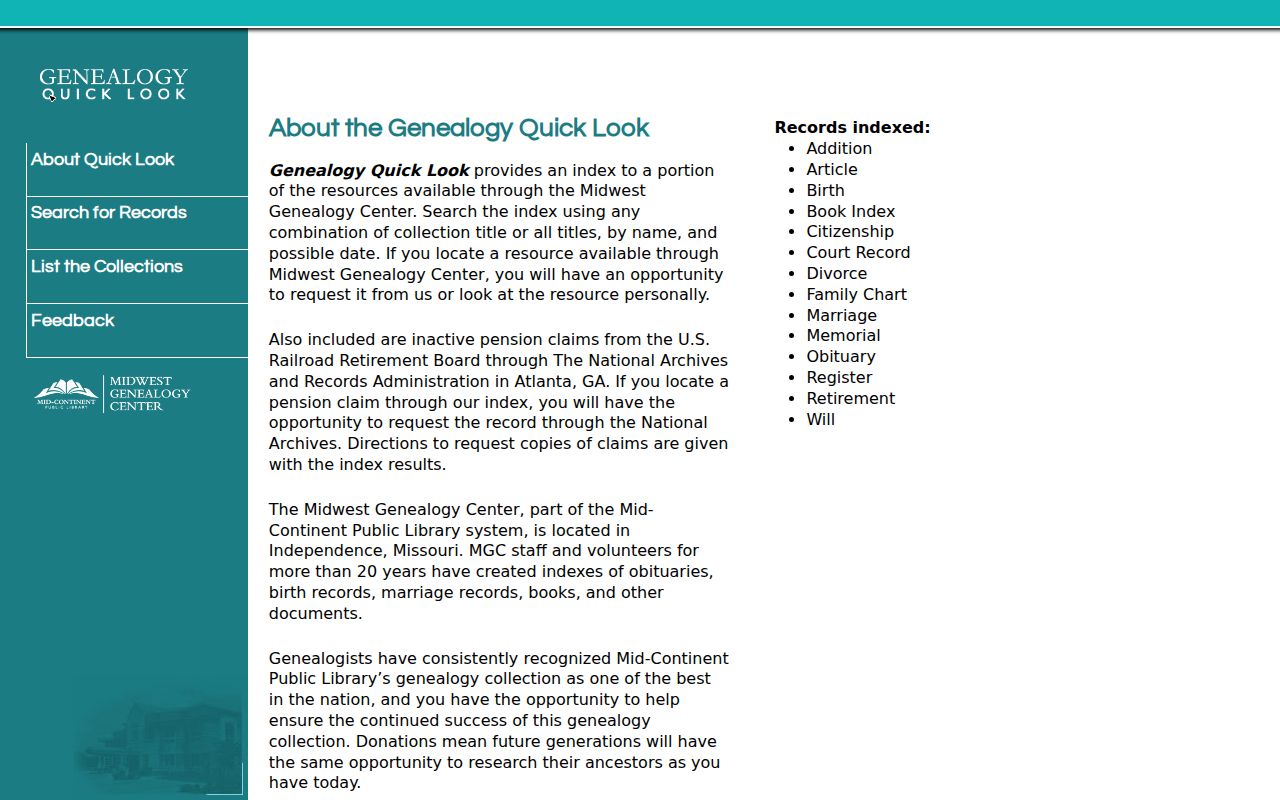
Save the collection title, item or resource number, indexed name, possible date, publication or record type, and whether the next step is a scan request or in-person view. That record trail makes a later directory or obituary check reproducible.
Trace Blue Springs City Directory Years
Household tracing works best when one fixed fact anchors each comparison. Begin with a known name and address in the closest available Phonefiche year. Compare the same person across the next available volume, preserving the edition label and page rather than silently filling in missing years. Federal census records are public through 1950 under the 72-year rule, and the National Archives census research service can place a household in county or township context between directory snapshots.
- Find the target in the nearest available Blue Springs or area edition and record the page citation.
- Check the next earlier and later held volumes, treating gaps as gaps rather than proof of a move.
- Use a street section or criss-cross page, if present, to compare the address and nearby dated listings.
- Pair each directory result with the applicable census, deed, obituary, city record, or parcel source.
- Resolve a same-name conflict with an address, date, collection citation, and the original image or microform page.
A disappearance can mean a move, a death, an unlisted telephone, a change in the area covered, or a missing volume. The safer conclusion is simply that the listing was not found in that specific edition until another record confirms the change.
Blue Springs Examiner Time Line
Newspapers often supply the date that a directory cannot. MGC's Examiner sample explains that the Independence Examiner began as a weekly in 1898, became the daily Independence Examiner in 1905, and retained a weekly Jackson Examiner edition. The obituary index covers about 1900-1959 and is incomplete, while microfilm reaches from 1905. The Blue Springs Examiner holding is more limited, from January 3, 1991 through July 31, 2003.
| 1898 | Independence Examiner began as a weekly, according to the MGC sample. |
|---|---|
| 1905 | The publication became a daily Independence Examiner and retained a weekly Jackson Examiner edition. |
| About 1900-1959 | The MGC obituary index is available as an incomplete finding aid. |
| 1991-2003 | MGC lists Blue Springs Examiner microform for this bounded run. |
Search by publication date, edition, place mentioned, and page. A local notice may use Independence, Blue Springs, Grain Valley, or Jackson County language, so the newspaper title alone does not settle the community connected to a person.
Blue Springs Microform Research Paths
The MGC research service connects the local-history room with online archives, oral histories, maps, yearbooks, family histories, and library-only resources such as Ancestry Library Edition. Its Digital Gallery offers searchable items, archival collections, oral histories, finding aids, and indexes. For broader regional material, the Jackson County Historical Society research-request route asks visitors to make an appointment, recommends allowing at least a week for requests, and distinguishes free in-person research from possible copy, scan, or staff-research conditions.
The MGC local-history research page illustrates the library services that support a Blue Springs directory search when the volume itself is on microform.
Use MGC's local-history research information to choose a visit, database search, or collection request.

Bring the name, address, date range, edition label, and call number 40128. A focused request gives staff a practical way to locate a volume or related newspaper item without turning an incomplete index into a claim of no record.
Blue Springs Historical Place Labels
Older directory and newspaper research can use a place name that does not match a modern street grid. Blue Springs developed near the spring water, grist mill, and Little Blue River, then shifted toward the Chicago and Alton Railroad station after it was announced in 1878 about a mile east of the original settlement. The city was incorporated in 1880. A nineteenth-century record may therefore describe a township, county, post office, railroad station, creek, mill, tract, or later street address for the same broad community.
The City of Blue Springs history is useful for this geography, while the Blue Springs Historical Society's Dillingham-Lewis House, Chicago and Alton Hotel, and Train Depot connections are leads for property and community context. They are not current directories. Keep the historical label beside the source citation, then test it against a land description, map, newspaper date, or directory edition.
MGC's archival collections add Jackson County material such as school newspapers, cemetery records, organization files, local histories, maps, and family material. The Jackson County Genealogical Society finding aid also points to directories, census material, agricultural reports, land records, a 1948 highway map, and Blue Springs references. Those sources can identify the right collection or neighborhood context when a city directory name is incomplete. They should still be cited by item, date, and geographic scope, especially when a publication uses a county or nearby-city label.
Note: A historical reference to a post office or railroad center should not be treated as a modern municipal boundary or a current address.